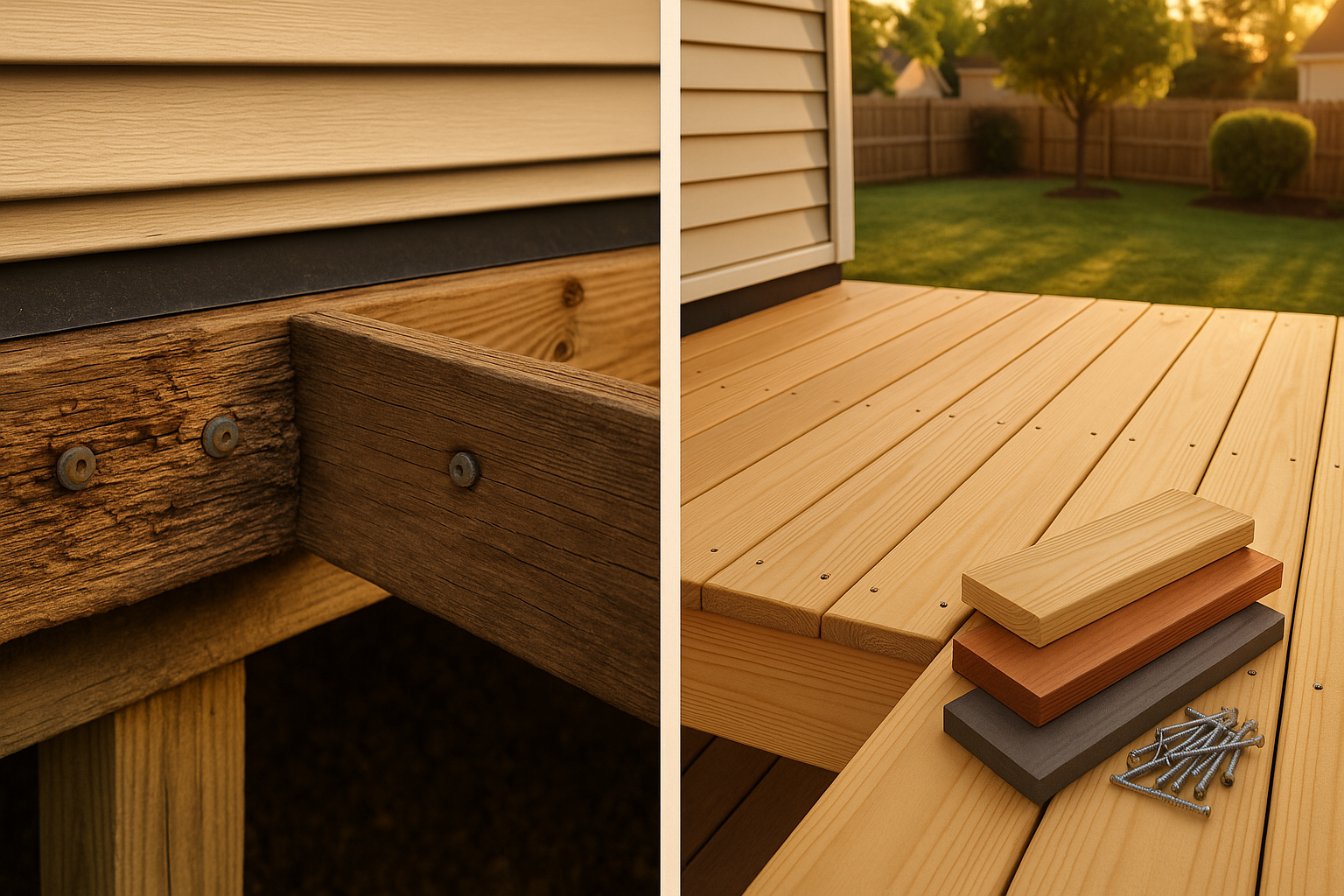
Last spring, a friend in Broad Ripple called me in a panic. One of his deck boards went soft under his foot, and the railing wobbled like a loose tooth. He thought he just needed a few boards swapped. But once we peeled back the old wood, the ledger board behind the house was starting to rot. That's a costly surprise nobody wants. If you're wondering about deck repair cost in Indianapolis, this guide breaks down real numbers and what drives them.
Typical Deck Repair Costs in Indianapolis
Let's skip the guessing. Here's what we see around Indy.
- Minor fixes (a couple of loose boards, small rail section) run $200 to $600.
- Moderate repairs (several boards, rail sections, some minor framing) land $600 to $1,800.
- Structural work (joists, beams, ledger, stairs) goes $1,800 to $5,000 or more.
- Resurfacing — new boards and rails over an existing frame — costs $15 to $35 per square foot.
Line items matter too. A single board swap is $30 to $75 per board with material and labor. Railing repair runs $40 to $85 per linear foot for wood, or $85 to $140 for composite or metal. Stair tread replacements are $150 to $300 per tread. Fixing a rotted post or footing? $250 to $600 each. Ledger flashing corrections land at $350 to $900. Professional handyman rates in Indianapolis usually fall between $75 and $120 per hour depending on access and safety.
These numbers aren't pulled from thin air. They match what we see from handyman rates in Indianapolis across the metro.
What Drives the Price Up or Down
A deck in Zionsville won't cost the same as one in Lawrence. Size matters, obviously. But material choice is huge. Pressure-treated southern yellow pine is the budget-friendly option. Cedar runs higher. Composite decks like Trex or TimberTech cost more to repair because the boards and fasteners are pricier, and matching colors takes effort.
Rot extent is the real wild card. One soft board might be an easy patch. But if the rot spread into the joists or the ledger, that's a whole different animal. Same with access — a second-story deck over a garden bed or a steep hill adds labor. Railing complexity also pushes the bill. A simple wood guardrail is cheaper to fix than a curved metal railing with glass inserts.
Central Indiana weather isn't kind to decks. Our freeze-thaw cycles, snow load, and humid summers speed up rot and loosen fasteners. That's why we see so many ledger flashing problems and stair issues. If you repair, use ground-contact pressure-treated lumber where needed. Swap in hot-dip galvanized or stainless fasteners. Add proper ledger flashing and post bases. That prevents a second repair bill two years later.
Repair vs. Resurface vs. Replace
Here's the honest math: if 20 to 30% of your deck boards are failing, or the framing has widespread rot, resurfacing or full replacement might be smarter long-term. You can patch forever, but at some point you're pouring money into a deck that's more patch than original.
A homeowner in Fishers told me she wished someone had said this earlier. She spent $1,200 on board replacements over two years, then found the joists underneath were half rotted. A resurface for her 12x16 deck with new boards and rails cost about $5,200 — less than repeating her patching cycle for another five years. New deck boards over a solid frame gives you a clean look and avoids the cost of new footings and posts. If the frame is solid, that's often the sweet spot.
You can check some common signs in our blog before calling anyone.
Permits and Codes in Marion County
Indianapolis and Marion County have rules. Structural changes — posts, beams, ledger work, stairs — often need a permit and inspection through the Department of Business and Neighborhood Services (BNS). Non-structural board swaps usually don't, but I'd always call or check with BNS or your HOA before assuming. HOAs in suburbs like Brownsburg, Avon, and Westfield often want finish color approvals too. Plan a little lead time for that.
Code stuff matters for safety. Guards need to be at least 36 inches tall. Balusters should have no more than a 4-inch gap. Stairs need proper rise and run. Connections at the ledger and posts have to be solid. We always check these on an inspection.
Quick checklist we walk through on every deck: - Ledger attachment and flashing - Posts and footings - Joists and beams - Rail height and strength - Stair stringers and treads - Guard and baluster spacing - Surface condition - Fastener type and condition
That's not a sales pitch. We've seen too many decks that look fine from the top but are a mess underneath.
Finishing and Weather Timing
After repairs, you'll want clean and stain or seal. That runs $1.50 to $4.00 per square foot depending on prep and product. Prep includes mildew wash, sanding, and setting any popped fasteners. Winter repairs are doable, but stain needs temperatures and humidity in spec. Spring and fall are perfect. Summer works if you avoid the dew.
Spring schedules fill early. If you want a fixed written quote before peak season, call us sooner than later. We work in Westfield, Brownsburg, Noblesville, and all over the metro.
What It's Like Working with HandyPros
We come out, look at the whole deck, and give you a line-item scope. No vague "deck repair" line. You'll see the boards, the rails, the stairs, the flashing — all priced out. We talk through options: repair what's broken, resurface for a cleaner look, or replace if it's past saving. Nobody likes scope creep. If we find hidden rot after starting, we stop and show you photos before touching anything else.
We also respect your yard. Gates stay closed, pets stay inside, and we haul away old material. A homeowner in Greenwood told us the cleanup was the best part of the job — not a single bent nail left in the grass.
If you're ready for a no-pressure look at your deck, get a written quote here. Or call us. We'll tell you straight whether it's worth fixing or better to start fresh. Your deck, your call, no upsells.
Common Questions I Hear from Homeowners
How much does it cost to replace damaged deck boards in Indianapolis?
Board swaps usually run $30 to $75 per board, including material and labor. If you have a few boards go soft, you're likely in that $200 to $600 range for a small repair.
Do I need a permit for deck repairs in Marion County?
For structural stuff — posts, beams, ledger, stairs — yes, often. Simple board replacements usually don't need one. Always confirm with BNS or your HOA, especially in suburbs like Plainfield or Avon.
Can you match my existing stain or paint color after repairs?
We do our best. Wood ages, so an exact match on an old stain might not be perfect. We'll color test a small area first and tell you if a full re-stain makes more sense.
What areas around Indianapolis do you service for deck repair?
We cover Indianapolis, Carmel, Fishers, Zionsville, Westfield, Noblesville, Greenwood, Brownsburg, Avon, Plainfield, and Lawrence.
Give us a shout. A deck assessment takes about 30 to 45 minutes, and you'll leave with a plan, not a guess.
Ready for a free estimate?
Send us the list, and we'll quote a flat price before we schedule — no pressure, no obligation.