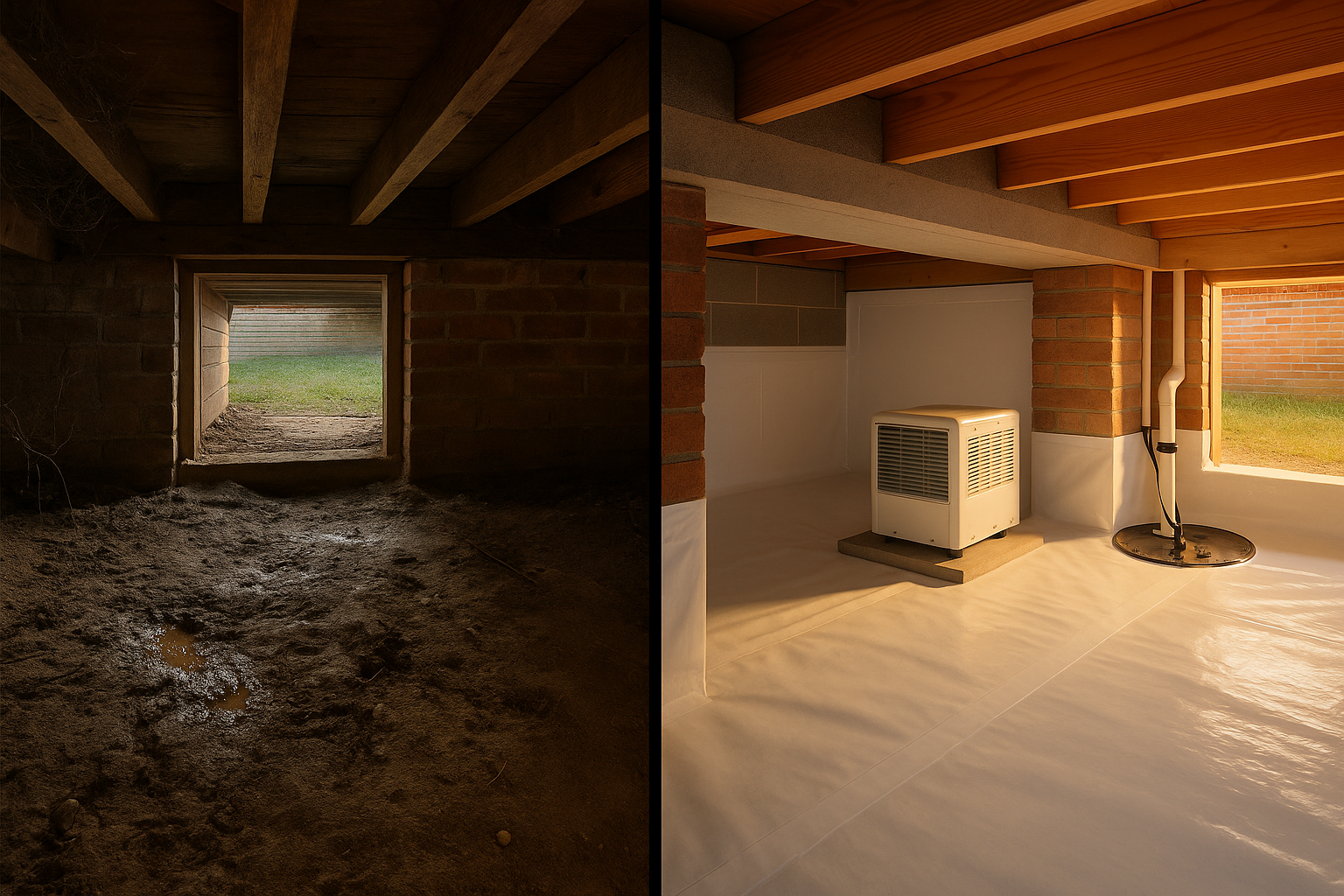
Last spring, my neighbor Dave in Broad Ripple called me over because his floors felt clammy and his living room smelled like a wet basement. He'd been quoted $18,000 for full encapsulation and thought he was getting ripped off. Turns out, he didn't need all that — just a proper liner, a sump pump, and a decent dehumidifier. That job ran about $9,500. Your crawl space could be more, could be less. Here's the real story on crawl space encapsulation cost in Indianapolis.
What It Costs: The Short Version
For most Indianapolis homes, crawl space encapsulation cost runs $4,500 to $12,000+ total. Break it down per square foot: basic sealing runs $3 to $7 per sq ft. Full systems with insulation, drainage, sump, and dehumidifier land at $7 to $15 per sq ft. Small, simple crawls with good access can come in under that. Tight, wet, or moldy spaces push higher. If you have a 1,000 sq ft crawl and you want the whole package, expect something like $8,000 to $12,000. That's not a rip-off — that's what it takes to do it right around here.
What Drives the Price Up or Down
Square footage is the obvious one. Then height. If a crew can't stand up, everything takes longer. Moisture is the big local factor. Indy's clay-heavy soils don't drain well. Spring storms and summer humidity push water vapor up through the ground. If your crawl floods after a heavy rain, you'll need drainage or a sump before any liner goes down. That adds real cost.
Liner thickness matters too. You'll hear 6 mil, 12 mil, and 20 mil. A 6 mil is basically a giant trash bag — it rips. 12 mil is the minimum I'd recommend. 20 mil vapor barrier price is higher, but it's tougher and lasts longer. That price difference shows up on your quote. Seam taping and sealing vents also add labor. Wall insulation, rim-joist air sealing, vent covers, a proper dehumidifier — each line item moves the total.
Line-Item Prices You Can Actually Compare
Here's what you'll see on a real quote from local contractors:
- Vapor barrier and tape: $1.50 to $4.00 per sq ft
- Wall foam board insulation: $2.00 to $4.00 per sq ft (walls only)
- Rim-joist air seal and insulation: $600 to $2,000
- Vent covers and door upgrade: $200 to $800
- Crawlspace-rated dehumidifier: $1,100 to $2,200
- Interior drainage or French drain: $1,500 to $4,000
- Sump pump with basin and discharge: $1,100 to $2,500
- Mold treatment (if needed): $800 to $3,000
- Minor repairs, debris removal, leveling: $300 to $1,200
These are for residential jobs in the Indy metro. Carmel, Fishers, Zionsville — same ballpark. Labor runs similar across the suburbs. The biggest variable is always water.
Three Ways to Scope It: Basic, Standard, Full
You don't have to go all-in. A basic job seals the floor and walls with a liner, taped seams, and vent covers. That's the old-school "vapor barrier" approach — it helps but doesn't stop everything. Standard adds wall insulation and a sealed access door. That's enough for many dry crawls. Full system adds drainage, sump, dehumidifier, and rim-joist air sealing. That's encapsulation vs vapor barrier: encapsulation means you're actually controlling the environment, not just covering dirt.
If you already have a thin barrier, you might wonder if full encapsulation is necessary. Here's my take: if your crawl is dry year-round and smells fine, maybe not. But if you get condensation on ducts or musty air seeps into the house, a thicker liner plus dehumidifier is worth it.
Local Indianapolis Factors
Our clay soil holds water like a sponge. Homes near the White River, Fall Creek, or Eagle Creek flood more often. Even in high-and-dry neighborhoods like Meridian-Kessler or Southport, heavy rain can push ground moisture up. Older homes in Broad Ripple, Irvington, and Fountain Square often have low, dirt-floor crawls — some under 3 feet. That tight access adds labor time and cost. And downspout extensions matter. If your gutters dump water next to the foundation, no encapsulation will fix it. Fix grading first.
Termites are a thing here. Eastern subterranean termites love moist wood. Code and common sense require leaving a 3 to 4 inch inspection gap along the foundation wall — don't cover the top of the wall with liner. Good Indianapolis crawl space contractors know this. Radon in crawl space is also moderate-to-high in central Indiana. Sealing the crawl can trap radon, so test before and after. Many pros include radon testing as an add-on.
Code, Radon, and Termites: Don't Skip These
Encapsulation changes how your crawl breathes. You're sealing out outside air, so you need a dehumidifier sized for the square footage and humidity load. The condensate line has to drain somewhere — usually to a sump or outside. Electrical for dehumidifiers and sump pumps should be GFCI-protected. Permits may be required for new circuits or discharge lines. Ask your contractor; don't assume. And about that termite gap: if you hire a company that buries liner up to the sill, run. You'll regret it when termites eat your floor joists and nobody can inspect.
DIY vs. Hiring a Pro
If your crawl is dry, has decent height, and you just want to roll out a basic liner, you can DIY for maybe $500 to $1,000 in materials. But here's the catch: taping seams in a tight, dark, damp space is miserable. You'll get dirt in the tape and wrinkles in the liner. And if you have standing water, mold, or need drainage, you're in over your head. Professional installation gives you tight seams, proper fasteners, and a warranty on workmanship. Crawl space sealing cost from a pro includes that know-how. Most DIY jobs look okay for a year, then peel up.
What HandyPros Includes (and What's Extra)
When we scope a job, we start with a moisture reading and a full walkthrough. Our quotes include the liner, tape, vent covers, access sealing, and basic insulation if you want it. We also clean out the crawl before we start. Add-ons are separate: mold remediation, new electrical circuits, exterior grading, gutter/downspout work, or radon mitigation. We don't hide those in the base price.
If you're also thinking about insulation upstairs, check out our attic insulation service. It pairs well with crawl work — kind of like sealing the envelope from both ends. And if you've had water damage from flooding, that needs to be fixed before encapsulation. We handle that too — see our water damage repair page.
Get a Real Quote Without the Guesswork
Every estimate should be line-item, not a single mystery number. We measure the crawl, take photos, and give you three options with material specs (12 mil vs 20 mil, dehumidifier capacity, etc.). The process usually takes 1 to 3 days for a dry crawl, 3 to 5+ days if drainage and sump go in. After it's done, you'll notice lower humidity, no musty smell, warmer floors, and fewer bugs.
If you want a real crawl space encapsulation cost for your house, give us a call or fill out the quote form. We'll come out and give you a fixed-scope quote with no pressure. That way you know exactly what you're paying for.
Learn more about our crawl space encapsulation service.
Ready for a free estimate?
Send us the list, and we'll quote a flat price before we schedule — no pressure, no obligation.