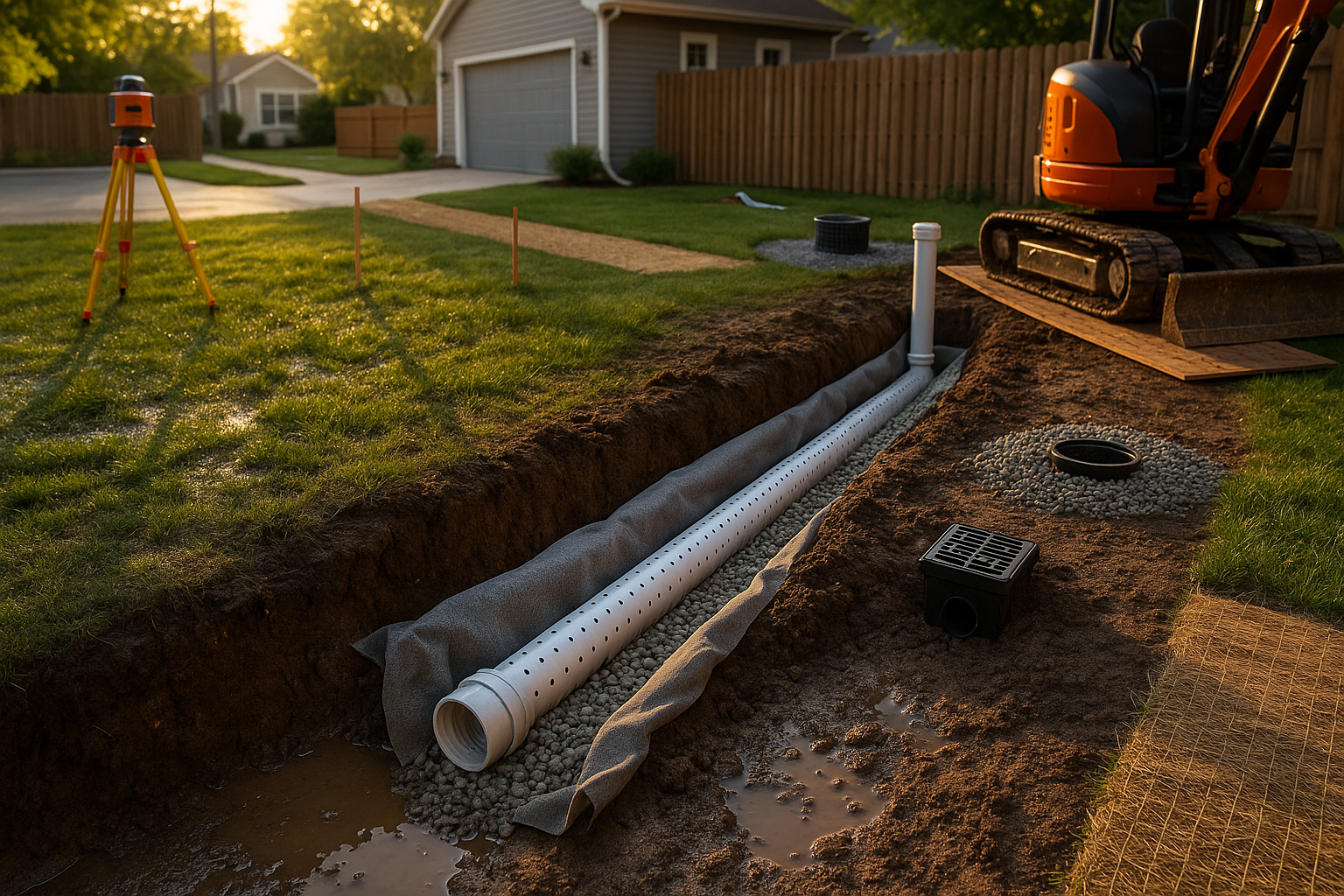
Tom stood in his backyard in Broad Ripple, pointing at a section of lawn that squished like a sponge. "Every spring, this whole corner turns into a wading pool," he said. His basement had that damp smell too. He'd already tried regrading with a shovel and running a cheap corrugated pipe from the downspout. Didn't work. What he needed was a real french drain, but he had no idea what it would cost. If you're in the same boat, here's the straight talk on french drain installation cost in Indianapolis for 2026.
What You'll Pay: Real Numbers from the Indy Area
For a straightforward yard french drain, most Indianapolis homeowners pay between $25 and $55 per linear foot. That covers the trench, pipe, gravel, fabric, and basic lawn repair. If you need a deeper system along a foundation, or the trench has to squeeze through a tight side yard with roots and utilities, the price jumps to $45–$85 per linear foot. Total project examples: a small problem area (30–50 ft) usually lands between $1,500 and $3,500. A medium yard run (80–120 ft) runs $3,500–$7,500. A complex system (120–200 ft) with catch basins and a sump tie-in can go $7,500 to $14,000 or more, depending on restoration.
That's a wide range, I know. The cost per linear foot french drain changes based on a few things we'll break down below.
The Big Cost Drivers (and Why Your Neighbor's Quote Might Be Different)
Most of the price comes down to how hard the digging is. Here's what matters most:
- Total length. More feet, more money. Simple.
- Trench depth and slope. A drain needs about a 1% slope (1 inch per 8 feet) to move water. If your yard is flat, we may have to dig deeper at one end to create that fall. Deeper trench = more labor, more gravel.
- Soil type. Indianapolis and the suburbs (Carmel, Fishers, Zionsville, Westfield, Noblesville, Greenwood, Brownsburg, Avon, Plainfield, Lawrence) sit on clay-heavy soil. Clay drains slowly, so you need a proper bed of washed angular gravel and a non-woven geotextile fabric to keep the pipe from clogging. That adds material cost but makes the drain last decades.
- Access for equipment. If a mini-excavator can reach the trench, the dig goes fast and cheaper. Hand-dig vs machine trenching? Hand-digging adds 20–40% to those segments. Tight side yards in older neighborhoods like Meridian-Kessler or Irvington often need partial hand work, protective plywood for fences, and staged spoils management.
- Pipe type. Perforated PVC vs corrugated pipe. Rigid PVC costs more per foot than the black corrugated stuff, but it resists crushing, holds slope better, and has smooth walls so water flows faster. We always use rigid PVC with serviceable cleanouts because it actually works long-term. Corrugated pipe is what you see at big box stores, and it kinks, collapses, and clogs. You'll pay less up front and regret it later.
- Number of basins and cleanouts. Each catch basin or cleanout riser adds a few hundred dollars. You want at least one cleanout at the start and any sharp turn.
- Distance to a lawful outlet. The drain has to discharge somewhere. That could be a daylight outlet on a slope, a dry well, or a tie-in to your sump pump. If the outlet is far or needs to cross a driveway, sidewalk, or curb, the cost goes up.
Outlets, Tie-Ins, and Add-Ons That Change the Price
A french drain only works if water can leave the pipe. Here are your options and what they cost in the Indy area:
- Daylight outlet installation. If your yard has enough slope to let the pipe exit above ground, this is the cheapest outlet. We install a grate and a splash block, usually $150–$400 depending on location.
- Dry well. On a flat lot, you can bury a large perforated tank or gravel-filled pit. A dry well can add $500–$1,500 depending on size and how much gravel it takes.
- Sump pump tie-in cost. If you have an interior sump pump, we can run the exterior drain into the sump basin. You'll need a check valve to prevent backflow and possibly a larger basin or pump upgrade. Budget an extra $300–$800 for the tie-in, plus electrical if the pump can't handle the extra water.
- Catch basin installation cost. If you have a low spot collecting surface water, a catch basin (a grated box) can capture that and send it into the french drain. Each basin adds $200–$450 installed.
- Downspout drain extensions. Tying a downspout into the french drain keeps roof water from saturating the soil near the foundation. Each connection adds $100–$250. This is a smart move for older homes with short downspouts.
- Permits for drainage Indianapolis. Most residential french drains don't need a city permit, but if you discharge to a public right-of-way or storm inlet, you may need approval from the Department of Public Works or your HOA. Some suburbs have their own rules. Always call Indiana 811 before any digging—it's free and required by law. They'll mark underground utilities so we don't hit a gas line or fiber optic.
- Grading and lawn restoration cost. The trench itself gets backfilled and compacted, but the top layer won't look perfect right away. We usually include raking, seeding, and straw matting in the base price. If you want sod, that runs about $1–$2 per square foot. If we have to regrade the whole yard to fix negative slope, that's separate and can run $2,000–$5,000.
DIY vs Hiring a Pro: Honest Math
Can you DIY a french drain for less? Sure, if you have a strong back, a lot of free time, and a high tolerance for clay. Materials alone might cost $10–$15 per linear foot for corrugated pipe, cheap gravel, and landscape fabric. But here's what you're up against: digging a 12-inch-wide, 24-inch-deep trench in Indiana clay is brutal. Renting a mini-excavator costs $200–$400 a day, and if you've never run one, you'll waste half the day learning. Then you must get the slope right, wrap the pipe properly, and haul away excess dirt. Most DIY drains fail because they use thin fabric, flat pipe, or no cleanouts. A drainage contractor Indianapolis brings a laser level, experience with clay, and proper materials. You pay for that knowledge.
Timeline, Mess, and What Happens to Your Yard
Most residential installs take 1–3 working days. The equipment is a mini-excavator, so it's not super loud, but it will tear up a strip of lawn two feet wide. We lay plywood boards to minimize damage, but there will be dirt. After we backfill, the trench line settles over a few weeks. Grass seed takes 2–4 weeks to germinate in spring or fall. If we install in winter when the ground isn't frozen, we can do the digging and pipe, but final lawn restoration may wait until spring. That's actually a good time because you get a head start on spring rains.
For maintenance and cleaning costs, inspect your catch basins and cleanouts every year, especially if you have mature trees. Leaves and roots find their way in. Professional flushing or jetting every 3–5 years runs $150–$400, depending on length. You can also hire a company like HandyPros for drain cleaning if you notice slow flow.
Questions I Hear All the Time
Will a french drain freeze in Indianapolis winters?
If the pipe is buried below the frost line (about 30–36 inches in central Indiana) and installed with proper slope, it shouldn't freeze. The water runs out before it sits. The outlet grate can ice over, but that's usually not a problem.
What if there's no downhill daylight outlet?
Then we use a dry well or tie into your sump pump. A dry well holds water underground and lets it soak into the subsoil slowly. It works fine in most Indy yards as long as the soil isn't pure clay without any percolation. A sump tie-in pumps the water out through your existing system.
Do I need a permit or HOA approval?
Usually not for a private property french drain. But if you discharge to a curb, storm sewer, or public right-of-way, yes—you need city approval. HOAs may require landscape restoration to match the rest of the yard. We handle the paperwork and check before we dig.
What's the difference between a french drain, trench drain, and dry well?
A french drain is a buried pipe that collects groundwater and moves it away. A trench drain is a surface channel with a grate, often used on driveways or patios. Trench drain vs french drain cost: trench drains are more expensive per foot because they use precast concrete or polymer channels. A dry well is just an underground storage pit for water that can't dayline.
What are signs my existing french drain has failed?
Water pooling in the same spot after rain, a wet basement wall, or a soggy trench line that never dries. That often means the pipe collapsed, the fabric clogged with clay, or the outlet got buried. We can inspect and repair water damage if it reached your foundation.
Get an Itemized Quote Before You Dig
The only way to know your exact french drain installation cost is to have a pro walk your yard, shoot elevations, and map a realistic outlet. That's what we do. We'll give you a line-by-line estimate with the materials, linear footage, outlet plan, restoration, and timeline. No hidden costs after we start digging.
If you're tired of the spring swamp in your backyard, or that damp smell in the basement, click here to request a free on-site drainage assessment. We'll come out, mark the route, and tell you exactly what it'll take. You can also check out our blog for more tips on keeping water away from your foundation.
Ready for a free estimate?
Send us the list, and we'll quote a flat price before we schedule — no pressure, no obligation.