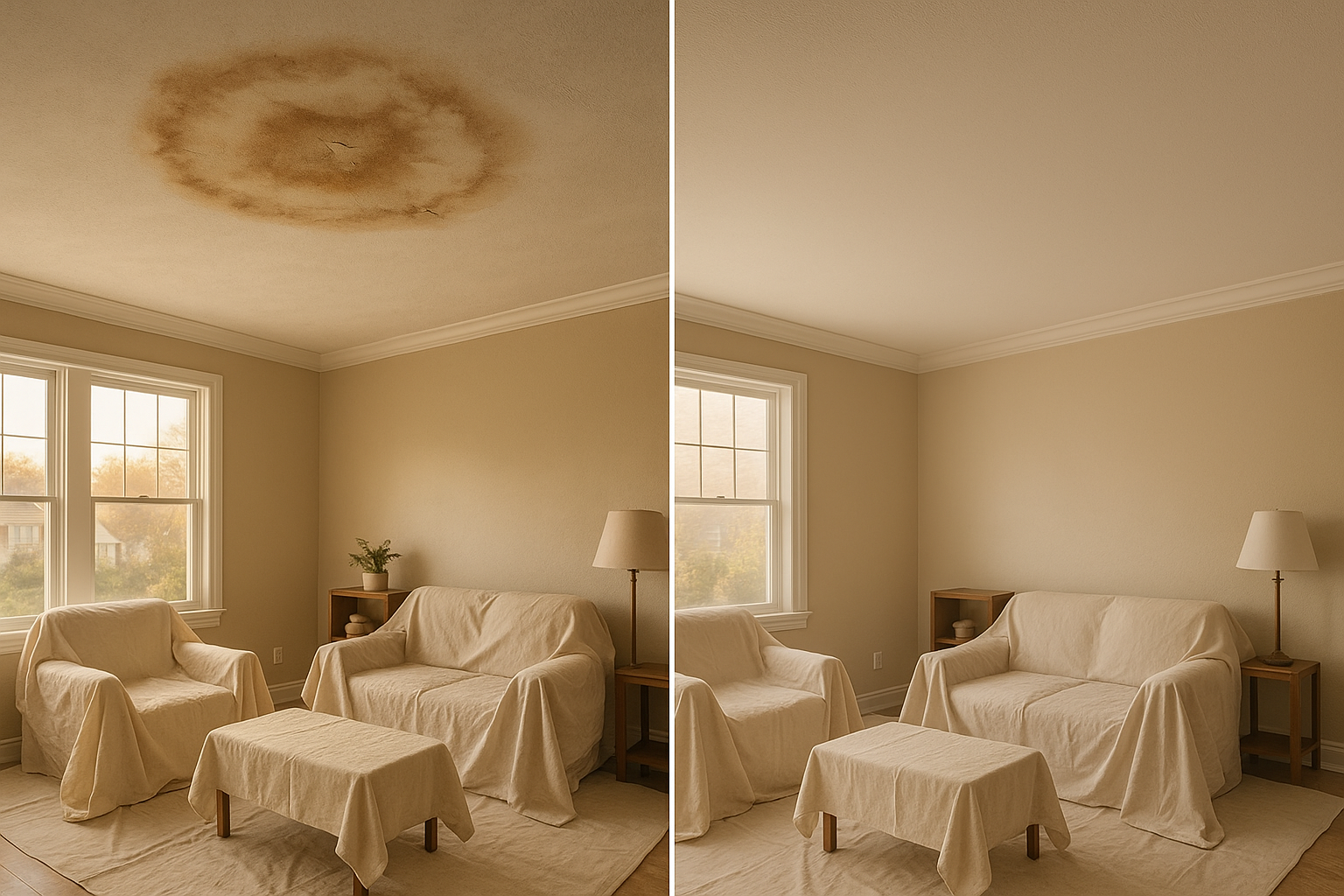
Last spring, a woman in Broad Ripple called us about a brown stain on her living room ceiling. It looked like a coffee ring, but bigger. Two weeks later, the drywall started to sag. She had a roof leak from an ice dam back in February. By the time she noticed, the ceiling was toast. She was worried about the mess, the dust, and whether the patch would ever match. That's the kind of job we do all the time. If you're searching for drywall repair Indianapolis, you're probably dealing with something similar: a hole, a crack, water damage, or just ugly tape lines. We get it. We're a small local crew — not a franchise — and we've been fixing walls in Indy for years. You can read more about who we are on our home page, but the short version is we show up on time, clean up, and charge a fair price.
Common drywall problems in Indy homes
Here's the thing about drywall in central Indiana: it moves. Freeze-thaw cycles make the framing shift a hair, and that hair is all it takes to show a crack along a seam. Hairline cracks in ceilings, corners, and above doorways are super common in homes all over Indianapolis, Carmel, Fishers, and Greenwood. We also see a ton of nail pops — little bumps where the drywall screws or nails backed out just enough to crack the mud. They're ugly but easy to fix.
Then there are holes. Doorknob holes, TV mount holes, holes from electricians cutting for outlets, or the classic 'I tripped carrying a dresser' hole. Drywall patching is straightforward if you know what you're doing. Cut out a square around the damage, back it with a wood block, screw in a new piece, tape, mud, feather, sand, texture, paint. If you skip a step, the patch shows. We don't skip steps.
Water-damaged drywall is another story — especially on ceilings. Roof leaks, ice dams, and plumbing pipes that let go in winter leave behind stained, bubbled, or sagging sections. Ceiling drywall repair usually means cutting out the wet area, checking the insulation above, and making sure the framing is dry before we close it up. In bathrooms and basements, we use mold-resistant board. That green or purple stuff isn't just a gimmick; it holds up better in damp spots. Mold-resistant drywall replacement is standard for us around tubs, under sinks, and in finished basements where the concrete can sweat.
If your home is older — think Meridian-Kessler, Irvington, or Butler-Tarkington — you might have plaster-over-lath walls instead of modern drywall. Plaster repair in Indianapolis is a different animal. You can't just slap on a patch; you have to stabilize the old keys, sometimes use plaster washers or a bonding agent, and then skim coat to match. We'll talk more about that below.
How we keep the mess from taking over your house
You know the worst part of drywall repair? The dust. It gets everywhere. In your hair, on your couch, in every corner of the kitchen. We hate it too. So we go overboard on dust control. Before we even mix a pan of mud, we tape plastic sheeting over doorways, cover floors with rosin paper or drop cloths, and move or cover furniture that can't leave the room. When it's time to sand, we use a HEPA vacuum attached to the sanding pole. That catches most of the dust at the source. No clouds. No coughing.
Last summer, a landlord in Fountain Square needed a rental unit patched and repainted before a new tenant moved in three days later. The place was empty, but she still didn't want dust in the vents or caked on the window sills. We set up a dust barrier in the hallway, used low-dust joint compound, and vacuum-sanded every coat. The tenant moved in and never knew we'd been there. That's the goal: tape and mud repair that looks original and leaves no trace except the fixed wall.
Matching textures and making it look untouched
Here's where a lot of handymen fall short: texture. Your walls and ceilings have a specific texture — maybe it's a light orange peel (super common in homes built after the '90s in Fishers, Westfield, and Avon), maybe a heavier knockdown in Geist or Noblesville, maybe a smooth finish in a renovated bungalow in Broad Ripple. If the patch is smoother or rougher than the wall around it, it catches the light differently and screams 'I got repaired.'
We take texture matching seriously. For smooth walls, we feather the mud out wide — sometimes 12 to 18 inches beyond the patch — so the transition disappears. For orange peel, we use a hopper gun or a can of spray texture, then knock it down just enough to blend. Knockdown is trickier: you have to match the size and pattern of the original splatter. We've done enough drywall finishing in Indianapolis to know what each neighborhood's houses look like. We'll even do a small test patch on a scrap board if we're unsure.
Popcorn ceilings are their own thing. If you have a water stain on a popcorn ceiling, we can scrape a small area, spray new popcorn, and dab paint to blend. It's never perfect from six inches away, but from normal height, you can't tell. And we always offer a primer and paint package. You can paint it yourself if you want, but we can also do it and leave you a ready-to-hang-pictures wall.
Older plaster and structural cracks — we don't just cover them up
Some cracks are cosmetic; some mean something else. A hairline crack above a door frame in a 1960s ranch in Greenwood is usually just normal settling. Tape it, mud it, and it stays gone for years. But if you have a crack that opens and closes with the seasons — wider in winter, tighter in summer — that's a movement joint. If we just tape over it, it'll crack again next winter. For those, we might use a flexible mesh tape or an elastomeric compound that can stretch a little. We'll also look at the big picture: is there a downspout dumping water at the foundation? Is the soil around your house expanding and contracting with the clay? Sometimes the fix is outside, not on the wall.
In older plaster homes — I'm talking Meridian-Kessler, Irvington, Woodruff Place — the walls are often plaster over wood lath. The plaster keys break over time, and the whole wall can feel bouncy. For a small crack, we'll stabilize with adhesive and washers, then skim coat with a setting compound. For bigger areas, we might cut out the loose plaster and patch with drywall, then skim the surface to match. We won't pretend a plaster wall is drywall; it's a different material, and it responds differently. But we've repaired enough plaster in Indianapolis to know how to make it solid again.
Garage walls, fire ratings, and other 'boring' but important stuff
Here's something most homeowners don't think about: the wall between your attached garage and your house has to be fire-rated. That means Type X drywall, 5/8-inch thick, with special tape and mud at the seams. If you have a hole in that wall — say, from a bike handlebar or a moved workbench — you can't just use any old 1/2-inch patch. The patch has to restore the fire rating. We check the thickness, use the right board, and make sure the joints are taped and mudded correctly. Garage drywall repair is one of those things that looks simple but has code requirements. We'd rather do it right than do it fast.
We also see garage ceilings with water stains from a leaky roof or from the upstairs bathroom. Same deal: fix the leak, cut out the bad section, replace with the proper board, tape and finish. And if your garage is detached but finished, we can match the existing texture, which is usually a rough orange peel or just flat.
Water damage: find the source before you patch
Water-damaged drywall repair isn't just about cutting out the wet stuff. If you don't stop the water, the new drywall will get wet again. We always ask: Where did the water come from? A roof leak? A cracked pipe? Condensation from a bathroom vent? Basement seepage from heavy rain? Sometimes the source is obvious; sometimes we need to run a dehumidifier and take a look with a moisture meter.
We once repaired a basement wall in Noblesville where the tape had bubbled and the drywall was soft along the bottom two feet. Turns out the downspout outside was dumping water right next to the foundation, and the clay soil was holding it there. We told the homeowner to fix the drainage first — extend the downspout, grade the soil away — then we came back and cut out the damaged section, replaced it with mold-resistant drywall, and used a setting compound that dries harder and resists moisture better than regular pre-mixed mud. Now the wall is solid, even after a week of spring rain.
If you have a bathroom that's always steamy, we'll recommend greenboard or cement board around the tub and a better exhaust fan. And we won't close up a wet wall until the framing reads dry on our meter. That's just common sense.
Small holes, big impact: quick repairs for homeowners and realtors
Not every job is a big production. Sometimes you have a fist-sized hole from a doorknob, a bunch of small nail holes from pictures, or a patch where an electrician cut into the drywall to add an outlet. Those little things can hold up a sale or eat into a security deposit. We get calls from realtors in Butler-Tarkington and Fountain Square who need a wall touched up before a buyer's walkthrough. We also get landlords with rental units near downtown or IUPUI who need a turnover done fast — patch the holes, fix the closet door dent, touch up paint, and get the unit ready for the next tenant.
Small hole in wall repair is usually quick. We'll cut a neat square, screw in a patch, apply a couple of thin coats of mud, sand, texture, and prime. If you're handy, you can do it yourself, but the difference is the finish. A badly feathered patch looks like a band-aid. A good patch is invisible. For multiple small holes, we can bundle them into one visit and give you one line-item quote so you know exactly what you're paying for. No mystery minimums, no 'while we're here' upsells.
If you need a bigger job — say, new drywall in a remodel or finishing a basement — check out our full handyman services page. We do everything from hanging board to final texture, and we work with your schedule, not the other way around.
Ready to stop staring at that hole or crack? Get a clear, itemized quote from HandyPros. We'll come out, look at the damage, tell you what it'll take to fix it, and give you a straight answer on cost and timing. No pressure, no fluff. If you're ready, request a quote and we'll get back to you within one business day. And if you want more tips on maintaining an Indy home, our blog has plenty of real-world advice.
Ready for a free estimate?
Send us the list, and we'll quote a flat price before we schedule — no pressure, no obligation.