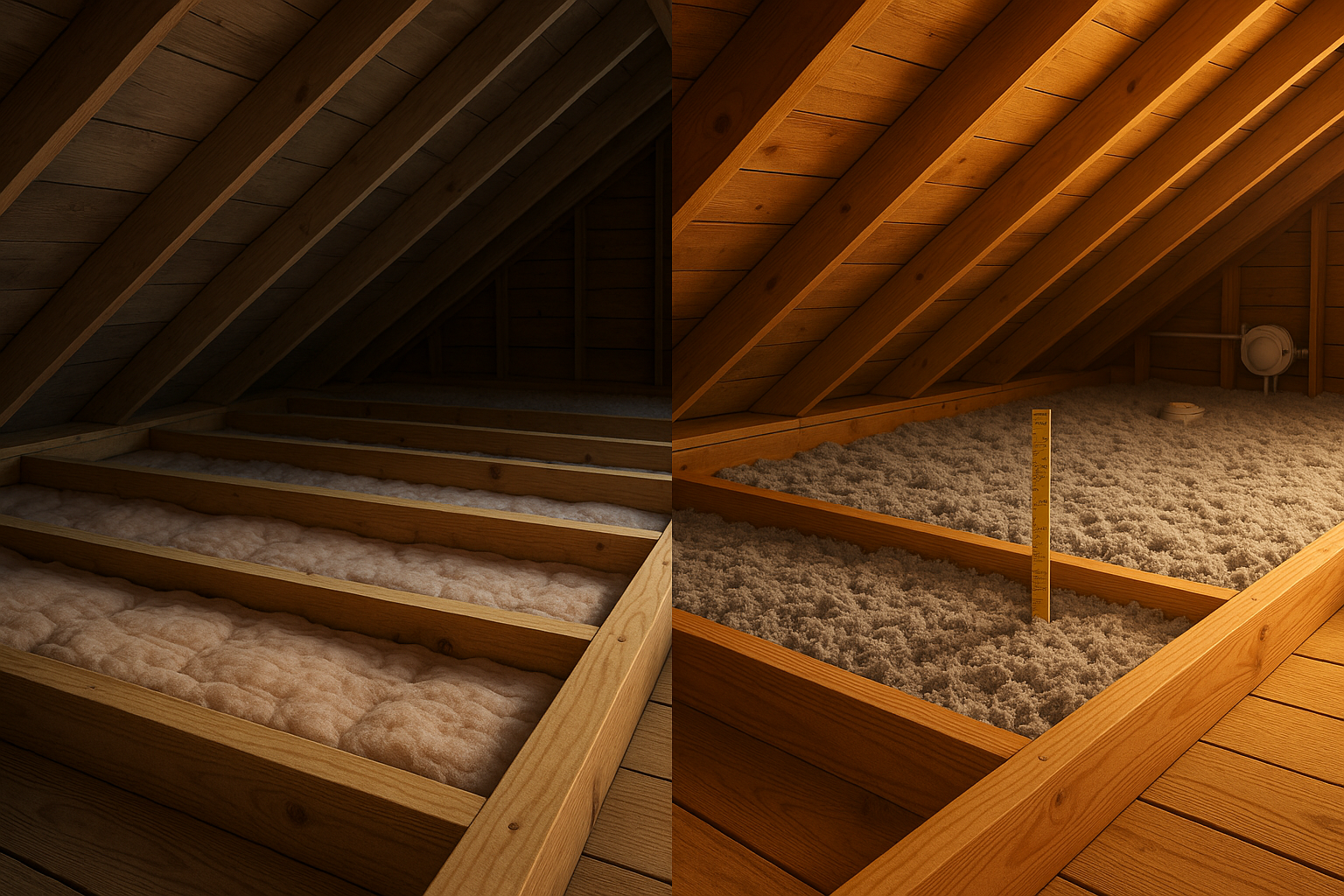
Last winter I got a call from a guy in Broad Ripple whose upstairs bedroom felt like a walk-in cooler. His furnace ran nonstop, but the heat never reached the kids' rooms. Turned out his attic had maybe 4 inches of old, flattened fiberglass. His R-value was about R12. We air sealed the gaps and blew in cellulose to R49. His next bill dropped 18%. That's the kind of fix we see all over Indianapolis, Carmel, Fishers, and the rest of the metro.
Why R-Value Matters in Indianapolis
Indiana sits in Climate Zone 5, which means cold winters and muggy summers. Most energy pros recommend R49 to R60 for attic insulation around here. Newer homes often get built with R49, but plenty of older places—especially 1920s bungalows in Fountain Square or mid-century ranches in Greenwood—are lucky to have R10 to R30. That's a thin blanket. Upgrading makes a real difference in how your upstairs feels and what you pay Duke or AES each month.
What You'll Pay: Attic Insulation Cost Breakdown
Attic insulation cost depends on a few things: square footage, what's already up there, and the material you choose. For a typical Indianapolis attic, blowing in fiberglass or cellulose to reach R49–R60 usually runs $1.25 to $2.75 per square foot installed. Fiberglass batts cost a bit more, around $1.50 to $3.25. If you want spray foam at the roofline to create a conditioned attic, open-cell runs $3.50 to $6.00 per square foot and closed-cell $4.50 to $7.50. Those are all-in prices for material and labor.
The cheapest option for most homes is blown-in cellulose or fiberglass. It fills irregular joist bays fast and does a good job. Cellulose gives you about R3.5 to R3.7 per inch, blown fiberglass about R2.5 to R3.2, and batts about R3 per inch. So to go from R12 to R49, you need roughly 10 to 12 inches of new blown material on top of what's there—unless the old stuff is wet or full of mouse droppings. Then you might need to remove it first. Removal and disposal adds $1.00 to $2.50 per square foot.
Other add-ons: attic air sealing costs $0.50 to $1.50 per square foot. Ventilation corrections and baffles range $200 to $900 total depending on attic size. If your attic is hard to access—tight hatch, low pitch—labor goes up. In neighborhoods like Lawrence or Avon, where homes were built in different eras, we see all kinds of attic layouts.
Air Sealing and Ventilation: Don't Skip These
Adding insulation without air sealing is like putting on a down jacket over a holey t-shirt. Warm air rises and escapes through gaps around pipes, wires, recessed lights, and the attic hatch. That stack effect pulls cold air in through your foundation and pushes your paid-for heat out the roof. A good crew will seal top plates, wire penetrations, bath fan housings, and the hatch. They'll also install soffit baffles to keep insulation from blocking airflow. Without enough ventilation, you can get moisture buildup, mold, and ice dams on north-facing roofs after snow-thaw cycles. We see ice dams all the time in Zionsville and Westfield—they happen when heat leaks into the attic and melts snow unevenly. Then water backs up under shingles and leaks into walls. If you've already got water damage from that, check our article on when water damage needs a restoration pro.
And about that old insulation: if it's clean and dry, you can often top it up. But if it's wet from a roof leak, full of raccoon poop, or has fire damage, removal makes sense. That costs $1.00 to $2.50 per square foot to remove and haul away.
Rebates and Tax Credits for Indiana Homeowners
The federal Energy Efficient Home Improvement Credit (25C) can cover up to 30% of your project cost for qualifying insulation and air sealing. That's a nice chunk. Local utilities like AES Indiana, Duke Energy Indiana, and NIPSCO also run insulation rebate programs from time to time. The details change often, so check with your utility before you schedule. A good contractor will help you figure out what applies.
The payback math works out. Upgrading a leaky, under-insulated attic to R49 with thorough air sealing can trim heating and cooling usage by roughly 10–20% in many Indianapolis homes. For a typical $2,000–$5,000 project, that means simple payback often lands in the 3–7 year range depending on fuel prices and how bad the starting condition is.
DIY vs Hiring a Pro
I've had homeowners say, "I'll just toss a few batts up there myself." That can work if your attic is open and empty. But most jobs need more than just unrolling fiberglass. Pro crews get consistent coverage, avoid compressing the insulation, work safely around wiring and can lights, and actually do the air sealing that makes the upgrade pay off. Plus, blown-in insulation requires a machine and some technique. HandyPros is a full-service handyman company, so we do attic insulation along with all the other small fixes around your house. We've done both residential and commercial attics, but homeowners are our bread and butter.
What to Expect During Your Attic Insulation Project
When you call us for a quote, we come out and measure, take photos, and check your current insulation depth and condition. Then we give you an itemized scope: target R-value, material type, air sealing locations, baffle count, hatch treatment, and any ventilation fixes. You'll know exactly what you're paying for. Most attics around 1,200 to 2,000 square feet finish in a half day or less. We protect your floors, clean up when we're done, and leave the hatch weatherstripped and covered.
If your upstairs is too hot in summer and too cold in winter, or your energy bills keep climbing, it's probably time to take a look at what's above your ceiling. We'll come out, measure, and give you a straight answer on cost and savings. No pressure, just numbers. Book a no-pressure attic assessment today. And if you need other repairs, check out our main site or read more tips on our blog.
Ready for a free estimate?
Send us the list, and we'll quote a flat price before we schedule — no pressure, no obligation.