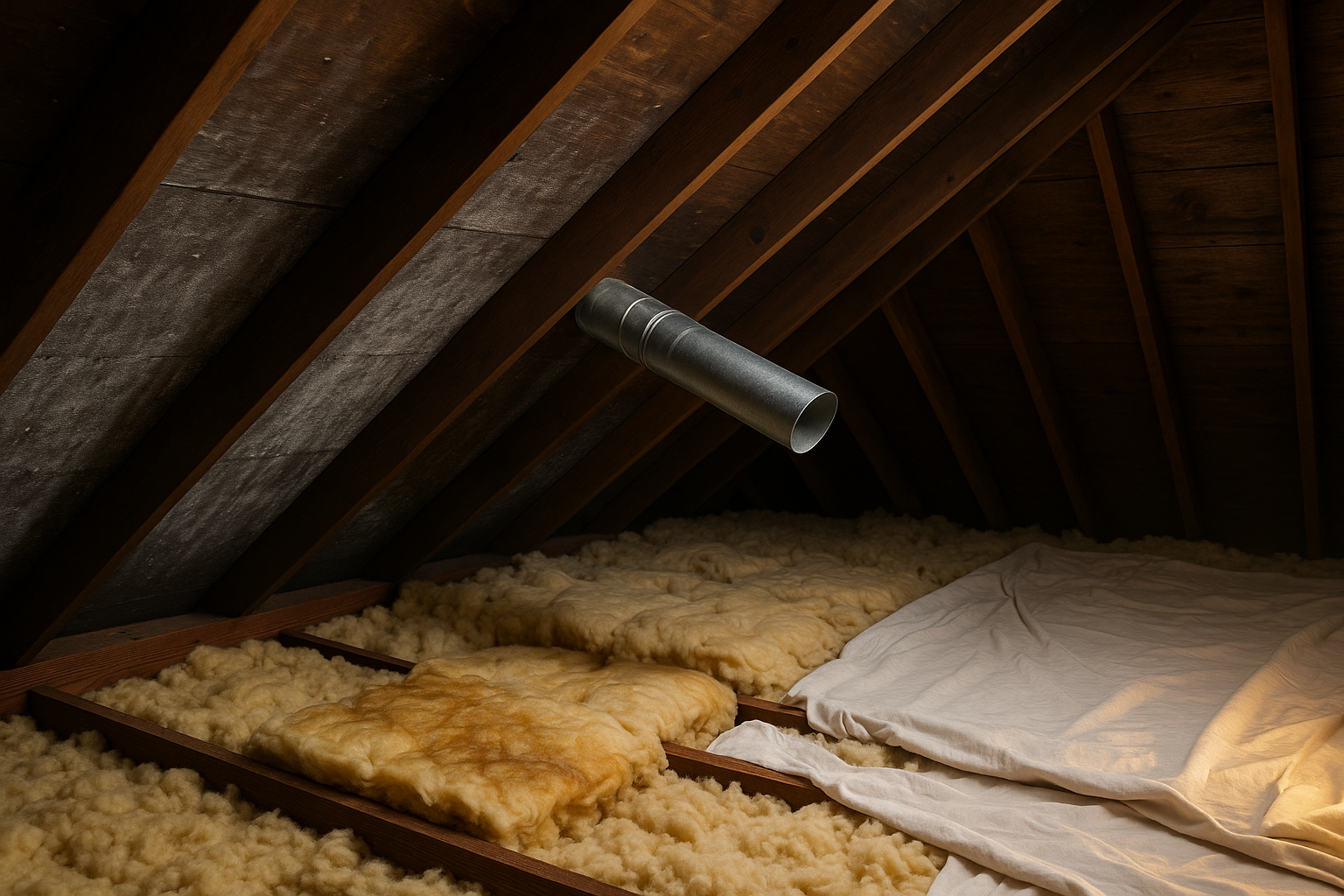
Last winter I got a call from a homeowner in Fishers. Her bathroom ceiling was peeling, and there was a faint musty smell she couldn't place. When I popped my head into the attic, the answer was right there: the bathroom fan duct just ended in the open attic, pointing at a rafter. Warm, humid air from every shower had been pumping into that cold space for years. The roof sheathing was stained dark, insulation was matted down, and on cold mornings there was frost on the roofing nails. That's what bathroom fan venting attic does—it turns your attic into a damp cave. And damp caves grow mold.
The Mold Problem With Venting Into the Attic
When you run a bathroom fan, it pulls hot, steamy air out of the bathroom. That air is loaded with moisture. If it dumps into the attic, that moisture hits the cold roof deck and condenses—just like a glass of iced tea on a summer day. In Indianapolis winters, the attic temperature drops below freezing, so that condensation becomes frost on nails, on the underside of the roof sheathing, and on any exposed ducts. Come spring, that frost melts and soaks into the insulation and wood. Over time, you get mold, rotten sheathing, and a musty smell that creeps into the house. I've seen attics where the fiberglass insulation was sopping wet and had to be pulled out entirely. So can a bathroom fan vent into the attic? No—not if you want to keep your house healthy. If you're noticing damp insulation or frost, you might want to check out our post on signs your attic needs more insulation.
What Indiana Building Codes Say About Bathroom Exhaust
Indiana follows the International Residential Code with a few local tweaks. The rule is simple: bathroom exhaust air has to go outside. Not into the attic, not into a ridge vent, not into a gable vent, not into an open soffit. Any of those shortcuts just moves the moisture problem somewhere else. The Indianapolis Department of Business and Neighborhood Services (BNS) is the local authority that handles permits for this kind of work. If you're replacing an existing fan in the same location with an existing duct, you probably don't need a permit. But if you're adding a new exterior termination—say, cutting a hole in the roof or running new duct—then a permit is wise. Not because the city is trying to make life hard, but because a botched roof penetration can cause leaks. A quick call to BNS can tell you what's needed for your specific job.
Roof vs. Soffit: Where Should the Air Go?
The most straightforward way to get bathroom air outside is through a roof cap. It's a small, dedicated hood that sits on the roof deck, with a damper that closes when the fan isn't running and a screen to keep out starlings and squirrels (yes, they love warm attic air). I've had to evict more than a few birds from old bath fan ducts. A roof cap is my go-to because it's simple and reliable, as long as it's flashed correctly. The other option is a soffit termination—that's the underside of the roof overhang. You can do it, but you have to be careful. If you blow moist air out of a soffit vent directly next to an intake vent, the air gets sucked right back into the attic. That's worse than doing nothing. So if you go the soffit route, you need a dedicated hood with clear separation from any intake vents. Personally, I prefer roof caps on most Indianapolis homes, but sometimes a wall cap on a gable end works well too, especially on two-story homes where roof access is tricky.
The Ductwork: Smooth, Insulated, and Sloped
The duct that carries air from the fan to the outside matters just as much as the fan itself. I always use smooth rigid metal duct. It's quieter, resists lint buildup, and lets air move efficiently. Flex duct—that accordion-style stuff—can sag and trap moisture, especially if it's run more than a few feet. If you do use flex, keep it short, pull it tight, and support it every few feet. But honestly, rigid is better. In an unconditioned attic, wrap the duct with R-8 insulated ducting. That prevents the warm, moist air inside the duct from cooling down and condensing before it exits. And slope the whole run slightly toward the exterior termination—a quarter inch per foot is plenty—so any condensation that forms drains out, not back into the fan. Seal all the seams with UL-listed foil tape and mastic, not duct tape. Duct tape fails in heat and cold. Support the duct every four to six feet to reduce vibration and noise. This keeps the air moving and your attic dry. If you're also dealing with insulation that's been compressed or moved, check out our guide on attic insulation R-value for Indiana homes to make sure you're not losing heat out the top of your house.
Choosing a Fan That Doesn't Scream but Actually Moves Air
A lot of homeowners pick a fan based on price or looks, then regret it when it sounds like a jet engine. The key numbers are CFM (cubic feet per minute) and sones (noise level). For sizing, you want at least 1 CFM per square foot of bathroom floor area. So a 50-square-foot bathroom needs a 50 CFM fan, minimum. If your bathroom is bigger or gets heavy use—like a master bath with a soaking tub—bump up to 80 or 100 CFM. Sones tell you how loud it is: a quiet fan is around 1.0 sone or less. You can barely hear it. My rule of thumb: spend a few extra bucks on a low-sone fan, especially if it's near a bedroom. And consider a humidity sensor or timer switch. That way the fan runs long enough to clear the steam without you having to remember to turn it off. It's a simple upgrade that prevents a lot of moisture problems.
What This Costs and How It Goes Down in Indianapolis
So what does it cost to fix a bathroom fan venting into the attic? It depends on what's already there. If you're just swapping an old fan for a new one and the existing duct already goes outside, you're looking at maybe $250 to $450 for the fan and labor. But if you need a new roof cap, new duct run, insulation wrap, and maybe a little electrical work for a switch, the job typically runs $500 to $1,000. That's the range I see around Indianapolis, Carmel, Fishers, and the northside. Roof access, attic height, and how much blown-in insulation we have to work around all play a part. The work usually takes half a day for a simple replacement, or a full day if we're adding a new exterior termination—weather permitting, of course. Winter attic work is doable, but we pick our days.
When HandyPros comes out, we start with a look in the attic. We check the current duct, the fan, the insulation, and the roof access. Then we give you a written quote that spells out exactly what we'll do, what materials we'll use, and how we'll protect your attic. We lay down drop cloths, move insulation carefully, and put it back when we're done. You get photos of the finished work—the sealed joints, the insulated duct, the roof cap flashing. No mystery.
But Wait, What About...?
A few questions I hear all the time:
Will a roof cap leak? Not if it's installed right. We use proper flashing and sealant, and we don't cut corners on the roof penetration. That's the part you want a pro for.
Can I just blow the air into my soffit? No. If the soffit is vented (which most Indianapolis homes have), the moist air gets pulled right back into the attic through the intake vents. It's a loop of moisture.
What if my attic has blown-in insulation? We'll move it aside, do the work, and fluff it back. We even use baffles near the eaves to keep the soffit vents clear. You won't know we were there except for the improved airflow.
Do I need a permit? For a new exterior termination, likely yes. For a simple fan swap, probably not. We'll help you figure it out.
My fan is dripping water. That's condensation collecting in the duct and running back. It usually means the duct isn't sloped, isn't insulated, or both. We can fix that.
If your bathroom fan is still venting into the attic, or if you're not sure, give us a call. We'll come out, take a look, and tell you straight what needs to happen. No pressure, just an honest assessment. You can schedule that right here.
Ready for a free estimate?
Send us the list, and we'll quote a flat price before we schedule — no pressure, no obligation.