My buddy Dave in Fishers called me last spring almost in tears. He'd bought one of those cheap metal shelving units from a big box store, anchored it to drywall with plastic anchors, and loaded it with paint cans and a spare tire. Two weeks later, the whole thing peeled off the wall like a bad sticker and nearly took out his car's side mirror. The cans didn't survive. Neither did his weekend.
That mess is why I started paying attention to garage storage ideas that don't fall apart. Around Indianapolis, we deal with snow, road salt, humidity, and the constant shuffle of bikes, yard tools, and holiday stuff. A good system has to hold real weight, handle temperature swings, and not eat up so much floor space that you can't park two cars.
Start With a Plan, Not a Pile
Before you buy a single bracket, empty the garage and sort everything into zones: parking, tools and DIY, sports gear, seasonal stuff, and a kids-safe area. Walk the walls with a tape measure. Most Indy garages have 8 to 10 foot ceilings and a garage door opener that hangs right in the middle. You need to know where the door tracks swing and how much headroom you have before mounting anything overhead.
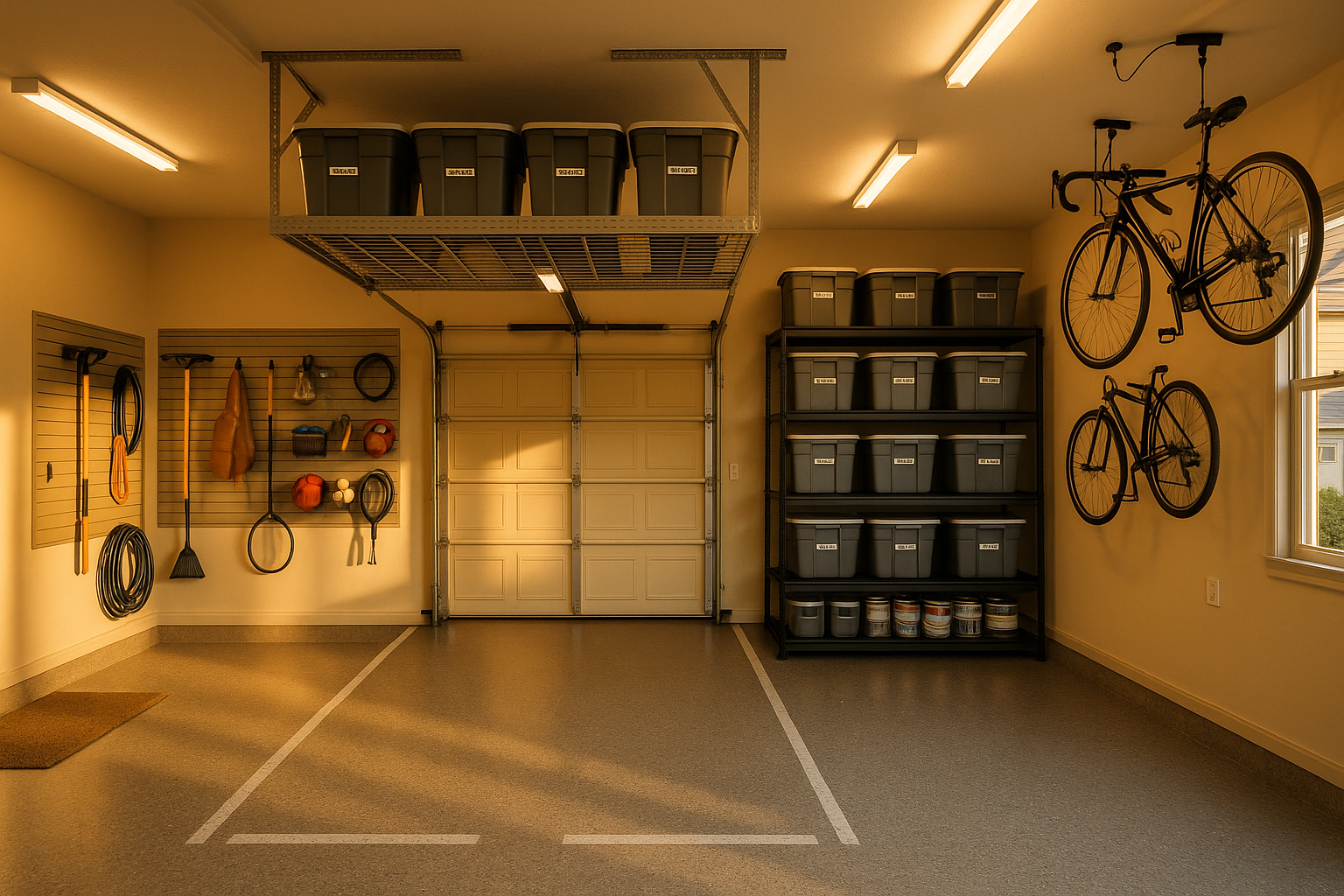
I always tell people to mark out the parking space with tape first. In a two-car garage, you want at least 8 feet of width per car, and you want shelving and hooks tucked tight against the walls. If you can't open your car door without hitting a bin, the system isn't working.
Use Your Walls Like a Pro
Vertical space is your best friend. For flexibility, slatwall beats pegboard every time. Pegboard hooks pop out when you grab a tool too fast. Slatwall holds baskets, hooks, and small shelves without falling out, and it looks cleaner. If you're on a budget, heavy-duty pegboard on furring strips works for lightweight stuff like gloves and extension cords.
Cabinets with doors are worth the money if you park a car that drips salt water in winter. Open shelves collect dust and that gray brine spray from the road. A set of wall-mounted cabinets over a workbench keeps saws, chargers, and chemicals locked up and dry.
For walls, you've got two common situations around here. Newer homes in Carmel or Fishers usually have drywall over wood studs. Anchor into the studs with lag screws and you can hang a small engine. Older places in Broad Ripple or Irvington often have concrete block or brick. You'll need sleeve anchors or wedge anchors, and a hammer drill. Not hard, but if you're not comfortable drilling into block, check out our guide on hanging heavy things on walls.
Shelves That Don't Sag
Those wire shelves with the particle board liner? They bow like a hammock after one Indiana summer. Go with adjustable steel racks or build your own from 3/4-inch plywood supported by steel brackets every 16 inches. Anchor the brackets into studs or use proper masonry anchors for block. Check the load rating on the bracket — a 12-inch bracket rated for 100 pounds per pair isn't enough for a shelf full of paint cans.
Heavy-duty shelf brackets are cheap insurance. I'd rather spend $8 per bracket and sleep at night than hear a crash at 2 a.m. and find my drill press on the floor.
Overhead Storage Done Right
Those overhead racks you see on TV look sweet, but only if they're mounted correctly. The rack has to bolt into ceiling joists or trusses, not drywall. Keep at least 18 to 24 inches of clearance from the garage door tracks and the opener itself. You don't want a tote jamming the door halfway up.
Store light, bulky items up there: Christmas decorations, empty suitcases, camping gear. Not the spare engine block. Most overhead racks are rated for 150 to 300 pounds spread across the whole thing, but that rating drops fast if you mount it to the wrong part of a truss. If you have any doubt, call a pro. We wrote a whole piece on when to call a handyman vs contractor that might help.
Bikes, Balls, and Yard Tools
Bikes eat floor space. Vertical bike hooks screwed into studs work great, and you can fit three bikes on one 8-foot wall. For riders who use their bike daily, mount a hook at chest height. For that old mountain bike you ride twice a year, use a pulley hoist up near the ceiling.
Yard tools like rakes, shovels, and string trimmers love track systems or slatwall hooks. Keep the edges pointed down and the handles clipped tight. Fuel cans for the mower? Up high, away from the water heater and any ignition source. That's not a suggestion — that's a fire code thing.
Sports gear works best in ventilated bins. A ball corral made from bungee cords and a wood frame keeps soccer balls from rolling under the car. Label everything. When my kids were little, we had a "grab and go" bin right by the house door with cleats, shin guards, and a water bottle. Saved ten minutes every practice.
Moisture, Salt, and the Unheated Garage
Indianapolis winters mean your car drags in road salt, snow, and slush. That stuff settles on the slab and wicks up into cardboard boxes and cheap metal tools. Put down a rubber mat or a good epoxy floor coating. A boot tray by the entry door catches the worst of it. Keep de-icer in a sealed plastic bucket, not the original bag that always tears.
In older detached garages (common in Meridian-Kessler), mice will chew through anything not sealed. Use latchable plastic totes instead of cardboard, and toss a couple of cedar blocks in each one. A small dehumidifier in the summer helps too — tools rust fast in that July humidity.
Light It Up and Park Like a Pro
If you can't see the mess, you won't organize it. Swap that single bare bulb for two or three LED shop lights, 4000 to 5000 Kelvin. They're bright enough to find a dropped screw and they don't flicker in the cold. Add a GFCI outlet near the workbench for battery chargers and a cordless vacuum. Route the cords with stick-on clips along the wall so they don't become trip hazards.
Here's a layout that works for a two-car garage in Westfield or Noblesville: one 24-foot wall gets slatwall from knee height to ceiling with a set of upper cabinets. Overhead racks go above the back third of the garage, behind the door tracks. Tape lines on the floor marking each car's spot. The center aisle stays clear — no shelves, no bins, no bikes.
Quick Wins and Real Costs
You don't need a full weekend to make a dent. In one Saturday morning, you can purge the obvious junk, install two 48-inch steel shelves against a stud wall, hang a slatwall panel near the door, toss a ball corral in a corner, and mount a couple of bike hooks. Live with that for two weeks, then reassess what's still in the way.
Budget-wise, a good freestanding shelf and some hooks might run you $200. Adding slatwall and steel racks gets you to $500–$800. Custom cabinets, overhead racks, and an epoxy floor can go $2,000 and up. But the number that matters is how much it costs when a shelf collapses and dents your car door. That's when the budget option looks expensive.
If you're in Indianapolis or a nearby suburb like Greenwood, Avon, or Plainfield, and you want a layout that's planned around your actual garage dimensions and your actual stuff, tell us what you're dealing with. We'll come out, measure, talk about what you actually use, and install something that holds the weight — so you don't end up like Dave.
Ready for a free estimate?
Send us the list, and we'll quote a flat price before we schedule — no pressure, no obligation.